
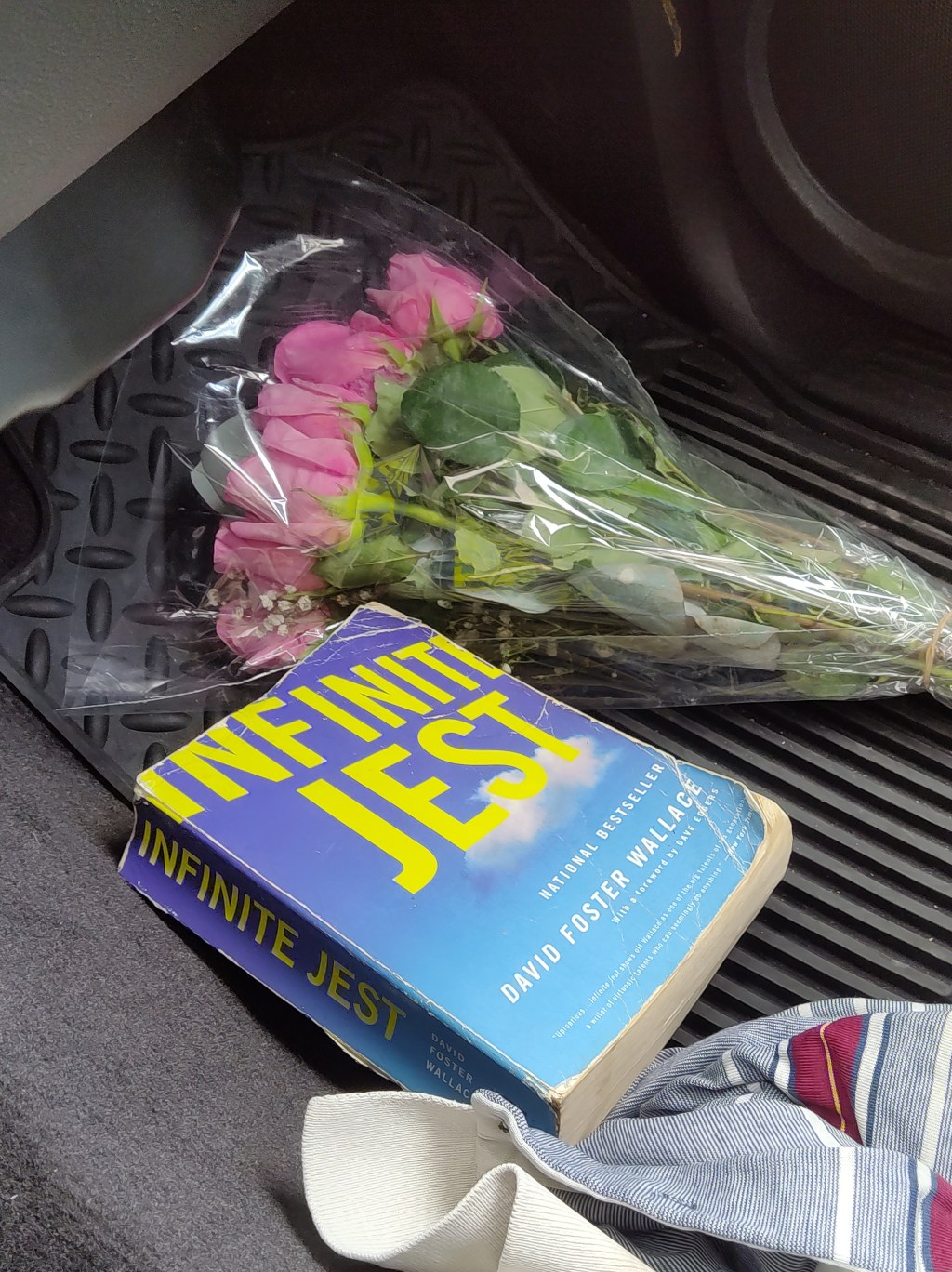
This past summer, I quit social media and dived deeper into my reading practice by finishing Infinite Jest. It’s not uncommon to have David Foster Wallace’s massive tome unfinished, haunting hipsters from the shelf. I caught up to where I was and vowed to quit social media, write a blog, read the book and make a video, reading the blog aloud. I had a lot of fun creating this, the video below. Original text below video.
I uninstalled all scrolling apps from my phone for many days.
Hours into day one, I found myself at the fork in the road where patterns break by revealing their impulse.
It all started on a sick day. Have you ever had a sick day and noticed it was pretty easy to spend the whole time, laying down, staring at your phone for the entire day—staring at it to numb yourself from your illness?
I reach for my phone and repeat a thumb movement, cuing for pictures, information and any release of visual, auditory and cognitive distraction.
At so many gaps of time in my living existence, I seem to fill them with this activity. Traffic lights, waiting in line, going to the bathroom and, I confess, even while riding a bike. Who among us hasn’t glanced at their phone while driving? Between sets and the gym, when I wake up in bed, and when I go to sleep. Scrolling.
Instead, for these few weeks, I reached for books. The impulse to be fed entertainment and stimulation is there. I sought the elder escape from reality. Books.
A feat that sounds pathetic, but with the way I was living, it feels somewhat virtuous to read books instead of mindlessly scrolling on a phone.
Scrolling social media is designed to be so passively easy. Looking around at my peers on earth, we can do it endlessly. Life and living have appeared to become interruptions of interfacing with our algorithm and what it has to “feed” us. A back-and-forth feedback look of media and data. Interesting that no two feeds on earth match. Yours is yours and yours alone.
Being on the phone often dampens my motivation. Especially watching motivational material. I passively pass over imprints of people I used to know and people I will never meet and look at a slice of their real life, their real thoughts, pictures of them doing real things as it is cast into the digital shadowland. It’s in the palm of our hand.
Just like when I stopped taking amphetamines, I was unaware of the severity of my attachment until I broke away.
Every time I got a notification on this first day without social media, I could practically hear the dopamine surge between my ears. Now, without the slow constant feed of my Instagram, TikTok, Facebook and whatever else feed I am fed, all I really get are texts from my wife. The next best thing to being with her in real life.
I kept asking the internet questions. Still eager for some excuse to stare at the phone in my quiet moments. Without it being intentional, I realized I just stopped listening to podcasts as well. I listened to music or even my own thoughts.
I found myself scrolling Venmo after sending a payment, curious about other people sending each other money and trying to decode their transactions through the attached emoji. So much this phone feeds the human desire of curiosity. I had to erase Goodreads a few days in as well as I was obsessively reading book reviews and curiously examining the reading habits of angry reviewers.
I still had the phone itself and I wasn’t extremely militant about my use and in the future would like to experiment with a dumb phone. Or perhaps being left on a desert island with nothing but a hatchet.
I was diagnosed with ADD and it seems as if anything I do that is beneficial or related to my life is also for my supposed ADD. This departure was good for my attention. It seems the media and activities we do in the dugout of our lives have a way to prime our attention span. Looking at 10,000 memes and ideas every morning divides my attention span into 10,000 little spaces, asking for 10,000 things to fill it. Turning away from the feed tubes, there were maybe 12 things. I am being hyperbolic.
In the beginning, I sent a few cartoons to a few friends to get some feedback that we both exist and sharing a sense of humor brings us together. I even looked at literature memes as I dove deeper into reading.
Phones isolate us in a stimulating way that somehow simultaneously brings us together. Then, being without the phone, I couldn’t help but feel like I stayed static as the world spun, despite being more present in my body and actions. It’s like the phone pushes us apart physically, while connecting us intricately with numerous weak digital threads.
This is more than a place to communicate. It has become a shadow environment of our world. It has grown intentions. Intentions of shaping and controlling the public perceptions, thoughts, and consensuses. These influences have proven they are capable of directing the final frontier of control—behavior.
Social media is probably making people less intelligent, more divided and played like a damn fiddle. But somehow I think my awareness of this happening grants me immunity from it. But I enjoy knowing what my friends are up to. I enjoy being able to send them memes. I enjoy memes. Before this fast, I easily inhaled, like, a hundred memes a day through my open eyes. Those are valuable chuckles. They must be good for my heart. Right? Plus, I need social media to promote my coming book: Hocus Focus, coming of age with ADD and its medicines (available now).
Can I garner a healthier relationship with social media without becoming some kind of analog hermit? How should I return from this sabbatical? In preparing for this essay, I’m already almost through The Odyssey and I don’t want to lose the interest.
Is it futile to resist? Is social media a problem, or am I just too impulsive? Am I the problem? If it’s just a tool like a hammer, it can both build and destroy. But I stare at this silly thing. It’s so hard to regulate. After being a drug addict once, am I forever burdened to latch on and latch off of dopamine giving activities? Will I now just cling to literature?
What is the healthy and productive way to interface with social media? Is it to perhaps give it a specific time in the day or week? Like episodic television, “Every Sunday at 10 am tune into the hit series, looking at Instagram on the couch while some other show plays in the background”
Should I say everyday I get 30 minutes? I challenge you to look at your phone’s log of your use and bear witness to how much you look. Maybe you’re better—but for me, I have been shocked by the reality of how often I look at this little glass computer. It’s so easy to slip into. And it feels good to be without it and not feel like something is lacking.
But good things slip in, genuine connections are formed, beautiful ideas expressed and actual human growth can be catalyzed! Likely while corroding some social aspect of human nature. However, there is no turning back. That’s why this piece is on the internet.
But I would advise myself to consciously sculpt and curate your media diet in a way that doesn’t exploit weaknesses. Don’t let it prey upon impulsivity. It can’t replace reality. It can only represent it. Again, like all valuable tools, in skilled hands can create beautiful, meaningful expressions. Handled recklessly—destructive to both the user and the environment they operate in.
There are rules to posting. Not just about content and words and things pertaining to censorship. There are unspoken rules of the feed. I have noticed by bending them. Doing so results in a strange sort of quiet and polite exile. I have experienced this consequence.
Meta-analyzing the phenomenon of “what-even-are-we-doing-here,” is perceived as contrived and annoying, but when I lose some kind of inhibition, I just can’t help myself. I get lost in the idea that we are so invested in the discourse simulation that we lose touch with the intended point of conversation and while I may think the dissonance is mutual, I may just be outing myself as confused and lost. Bringing it up holds whatever thing I’m commenting on hostage. To say anything to me would mean they are also confused and lost. Whenever I have become this babbling bag of wind and broken this 4th wall online, they have ignored it. Very well.
Most people lurk online. Much less react to posts, even less comment on them, and the fewest amount of people post occasionally and only a rare few seem to post regularly. Lurking is safe. Nobody can criticize you if you stay on the sidelines watching. You share your opinions in real life with those who trust and love you and you get to watch the show. Then those who post get to take part in casting a shadow to the wall and seeing if lurkers enjoy it. Although, they may turn around and ask you, “who the fuck you think you are to be holding a shadow, blocking their precious light? You’re doing it all wrong!”
Why is social media even such a big deal that I felt compelled to take a break and why would taking a break be significant enough to talk about in this format? It’s just me. I don’t know. I’m experimenting.
I fast sometimes. I don’t eat food for 48 hours. Whenever I break my fast, I come back to eating with a refreshed idea of the relationship I wish to cultivate with food and eating. I have this same sense now, but with social media. But I must confess, I usually am back to my previous eating habits within a week or two. So I am nervous about my return.
I have moved my bed closer to the wall to accommodate the charging cable. I have leaned over the edge of the bed just to look at nothing specific or important. Sometimes, for hours and hours, I stare at it. Eventually, putting it down to only reflect on the past day and the coming day for a few precious moments. If I don’t fall asleep right away, I’ll look again for a few more minutes. Looking for something that never seems to show up, but everything keeps my interest enough to keep looking. Only to pick it back up upon waking.
I have since gotten a sunrise alarm clock and must say. Having an alarm clock that doesn’t put the phone into your hand is a pleasant adjustment.
I can’t shake the habits of reading and writing. Instead of reading posts, I can read books, instead of writing satirical (only to me) comments on NPRs Instagram posts. I could edit my forthcoming memoir, Hocus Focus: Coming of age with ADD and its medicines. (Available for preorder, link in description) While I could slither away from scrolling neurodivergent housecleaning hacks on TikTok, I couldn’t escape interacting with language.
As if I didn’t have enough going on in my life, I finished Infinite Jest by David Foster Wallace. Literature became methadone for my media addiction. I am, by nature, looking for stimulation. Next time, maybe a week without reading anything.
It had been about a year since I opened Infinite Jest. I was about halfway through it. I caught up to where I was with online summaries and got back into it. I’m really grateful to all the people who discuss it online. I would have felt all alone without you folks. It felt like I wasn’t reading this book alone. I had all these people on YouTube to read with me. I kept YouTube. I didn’t consider it a scrolling app. But it is, and I definitely used it to satisfy the digital urge.
It surprised me how relevant Infinite Jest’s themes were to my considerations with my phone addiction.
I quickly immersed. Reading in the morning, before bed, during coffee, during lunch and other leisure opportunities. Just like I had previously with my phone.
Whenever you read any book by anyone, you are microdosing their mind. I suppose you could say the same about any media consumed.
This varies depending.
Having no social media, at times, made me feel alone
“The point of books is to combat loneliness. “
David Foster Wallace
A portion of the novel is centered on a piece of media so captivating that viewers can’t look at anything else.
Sound familiar?
Have you ever noticed that you don’t tire of looking at your phone? You can do it at all resting moments? It’s easy. It’s a casual way to interface with the world—with millions of people, lying on your back, chin to chest, blue light through your pupils, zeros and ones putting on a show. Keeping you in the loop. Notify, notify, respond, urgent, look at this cat. “We heard you talking about a wet bathroom. Buy this floor mat.” If, to stay interested, you need to hear that “All is well,” you will. If you need to hear that, “Things have never been worse,” so be it. Enjoy your doom-scroll. The phone reads you for what you desire and it’s getting very accurate.
The tumbleweed of an errant thought brought about by the mind simply being born and existing inside your mind
I could probably stand to testify to silence more often. To break from the absorbing and wringing out the verbal/visual sponge, I carry within my cranial cavity. The root of my phone addiction is the need for constant mental stimulation, entertainment, information and a sense of community—even if only in digital shadow puppetry. I don’t think any of this is uniquely uncommon.
I have been watching a screen my entire life.
Books have their advantages. They take longer.
I did notice without the interruptions of concept and subject that a diverse social media feed provides; I had questions that went deeper into my own life, its happenings, fundamental questions, as well as considerations of the text I was reading in my spare moments. Driving, brushing teeth, staring at walls.
Another unspoken rule I noticed online as I plundered into the wealth of commentary of Infinite Jest is not only must you complain of footnotes, you have to footnote your own work by saying you are aware of DFW’s missteps and abusive, erratic and odd behavior and you do not endorse that behavior, but you had to read this book. Yes, the book is peppered with racist, sexist language and perspectives. He was not the narrator, but he created them and he did not make excuses for his work like we all do now. The internet, and consequently the phone that accesses it, beyond anything else, serves to perpetually footnote everything. Reactions to reactions to reactions to reactions. I thought of reacting within this piece to a particular individual who expressed gratitude for the death of DFW. I’m going to avoid the specifics, to avoid a battle, but I will say this:
David foster Wallace took his own life. This act has to be footnoted from my point of view with the fact that he was withdrawing from some medications that cause such behaviors in their withdrawal, but not to say, if you have read this book, it was clearly something that was on his mind—a lot. He couldn’t stand the heat. He got out of the kitchen. The kitchen can get hot. You can learn to embrace the burn, stay in the kitchen. We want you to cook. For someone to celebrate his departure, is a disrespect to all folks in the hot kitchen. People can evolve, grow and get better. We are all works in progress and just…stay in the kitchen. You never know what you’ll cook up.
I confess with no irony or defense,—I enjoyed reading it. I am an easy audience. I try to like things when I can.
The writing was begging for my interest and I had to know. I had to read. Once things finally started to make sense, it was exciting and even fun. He was mad for writing this piece and at certain points in the tome; I was mad at him for his grotesque details of heinous acts. This book is not for everyone. I was legitimately pissed off. I am not reviewing it, but I would say, if you really want to throw in a personal element to your reading of the colossal work of Infinite Jest, quit social media while you read it.
While the book’s world was lingering in my mind, I couldn’t help but to see all media, advertisements and content as some sort of parody of itself. None of it feeling genuine. Even things like this video I’m making, a meandering self aware/ self indulgent piece of content that I have made here.
I quit using social media, intending to make a blog and video essay. I didn’t intend for it to involve Infinite Jest.
I got offended a few times for what he wrote, but all the while gawked at what he was doing with words. It’s some kind of mastery, be it chaotic, obnoxious and maximalist. It was mind-obsessed. It appeared he couldn’t stop himself. Like it was gushed out of him without his ability to stop and say, “Is this offensive?” or “Should I really subject the reader to this?” It just went and didn’t respect or hold the hand of the reader and that was part of why it seemed so compelling. It seemed like I was looking at something I wasn’t supposed to see, which at times truly unsettled me. Which is a reminder than I have boundaries.
Being offended shows that I have morals as well as limits. Being offended is a natural thing and I don’t think the response is to remove the offensive material. For me, I can acknowledge I was offended, understand that if this kind of thing didn’t offend me a bit, that would be odd. And move on to the next chapter.
At the same token, I once didn’t finish a sandwich because the guy at the shop who made it was in a bad mood and I didn’t want to consume something he put his energy in.
When you read someone’s book, you are microdosing their mind. Dose responsibly.
I get hung up on challenges. Challenges like quitting Instagram until I finish reading Infinite Jest and not returning until I write a blog about it and turn that blog into a video.
We are growing as a people. It is a hard and somewhat painful process.
What even is a footnote? It is defined as an ancillary[1] piece of information printed at the bottom of a page.
DFW’s footnotes in IJ are interruptions. The narrative gets so strong and sometimes a footnote and pops up that could have either been a parenthetical, in the manuscript or a chapter of its own. Or it’s like commentary (right?).
The interrupting footnotes reminded me of how I use my phone. I see a movie, a picture, I hear about a thing (nice example) and I look it up on my phone for more information. Little asides, fun facts, deeper dives and rabbit holes follow. Comments on posts are a form of group footnoting. A public forum for “Actuallys and “What abouts.”
We all know these phones aren’t the best things for our mental health. It was not predicted that the seemingly whole collection of information in our hands would screw us up so much. We didn’t expect that so much of it would involve our own personal interfacing with it. The opinions of others pummeled into our consciousness in varying dosages all day, into the nooks and crannies of our waning focus. Reminding us of our weaknesses. Forcing us to have an opinion on things that objectively don’t matter. Showing us the rich when we are poor, the leisure while we are busy, the insolent when we are kind and so on—sowing high vibrations of cognitive dissonance hopefully leading to an eventual online purchase or complete defabrication of society at large. Whichever comes first.
It is like an alternate reality, the shadows on the wall. Our internet selves and our in-real-life selves appear as separate entities with separate business. The digital self being cast off the actual self(I think much like that puppet in the cave of the philosopher. I only know through its repeated reference in society (Republic added to the list)). I can get a sense of what casts that digital shadow by looking at it. But I can’t know it. I can’t touch it. Only through my shadow can I interact with the other projections. (Shadow here representing my digital activity.) Still, in this piece, my ability to be clear from intention to execution may be faulty.
And that’s okay.
Yes. This is media. Yes, I created it, yes it’s talking about media in the media and yes, you are consuming it. Sorry.
Anytime you consume any media, you are microdosing the creator’s brain.
Podcasts, social media, group-chats, are places where the meme-of-the-day is shared, talked about, disseminated, celebrated, criticized, analyzed, meta-analyzed, recreated, re-captioned for your niche and on and on. Reacting to the reaction again and again till the action is a calm center surrounded by ripples. Ripples reacting to ripples, forgetting that there was ever a stone tossed into the lake.
Less media, fewer dots, easier time drawing connections. You can hear your thoughts when words aren’t constantly spoken into your head from this, that, and the other. Fewer forces that beg to borrow a lent ear.
Having a political opinion is unpaid labor. Listening to both sides is insane.
Especially with the phone thing. It’s so beyond out of control, it’s practically become a clean system. In real life, most people talk about the weather. Whenever I see a heated political post, I can’t help but imagine the poster, from either side of the “aisle,” lip wide, showing teeth, thumbing away at the glass in a fervor, boldly using all caps saying all the stupid wrong things with the conviction of truth in the heart.
Because, well, if they weren’t wrong, they’d believe what I believe, and it’s so hard to deal with all the people who have been deluded by this media entertainment machine into believing the wrong thing. It’s unhealthy and unfortunate that they don’t consume the correct memes. As you and I have. Right?
I know we’re right, right? You and I?. And isn’t it so hard to be correct in a world of wrongness? It’s isolating to feel like the only one who knows what’s really happening.
I am the arbiter of truth in my reality, so if it comes to me, I agree with it, then it’s true, I double tap and ask for more.
I’m enjoying my absence from the inescapable politics associated with the viewing of the infinite scroll.
I feel like the phone gives you answers without questions. Rapid fire delivery causing overwhelm and taking away that silent pause in the day, in the mind. Reading one book at a time allows for one idea or story to really steep in the mind rather than one thousand ideas peppered in and constant. 4 or 5 themes or ideas to be considered over a period of time.
It all comes down to time and how we use ours. I have problems in my life to solve, unrelated to my relationship to my phone, writing and reading. As I transferred my writing form posts and comments to books and blogs, I did notice that I am using the same urge for distraction through a different outlet. This will have to be explored at a later time.
The entertainment is in our hands. It and ourselves mutually consume each other. It consumes the data we willingly deposit in exchange for entertainment. I get to watch things in the world go on from the palm of my hand, fire up the mirror neurons and allow the simulated experience to satisfy my need for adventure, understanding, purpose, beauty, and love. Take it away and we are prone, staring at our hands.
[1] Providing necessary support to the primary activities or operation of an organization, institution, industry or system
 R.L. Kramer
Leave a comment