
How a Telehealth company capitalized on neuro-divergence and created massive demand for amphetmines
Bias disclaimer:
I used to take Adderall and don’t take it anymore.
Thanks for reading R.L.’s Substack! Subscribe for free to receive new posts and support my work.
Everyone has their own journey and mine has a central theme of not taking Adderall for ADHD.
No intentions to shame anyone for taking medication or influence the choice to take or not to take ADHD medication. My aim, however I may stray from it, is to examine the phenomenon of ADHD medication.
THERE’S A SHORTAGE OF ADDERALL
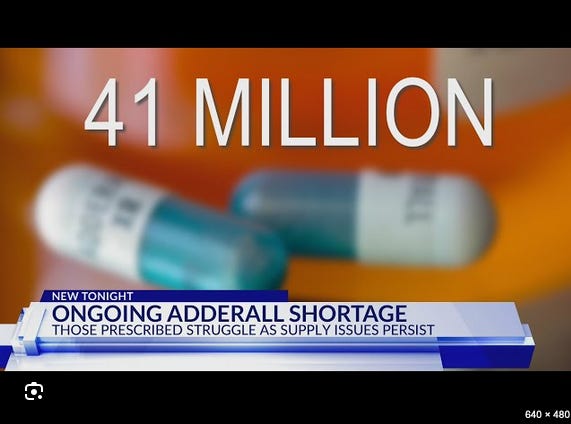
Everyone’s looking at the shortage — but nobody looks at the reason.
Like doctors treating symptoms and not illnesses. The Adderall Shortage is a symptom.
Done ADHD is a telehealth company that specializes in simplifying access to ADHD medication.
A post shared by @doneadhd
Done ADHD execs, Ruthia He and David Brody, were arrested after an it was discovered Done had defrauded pharmacies, Medicaid, and Medicare, pushing ADHD medication (amphetamines) on a vulnerable population.
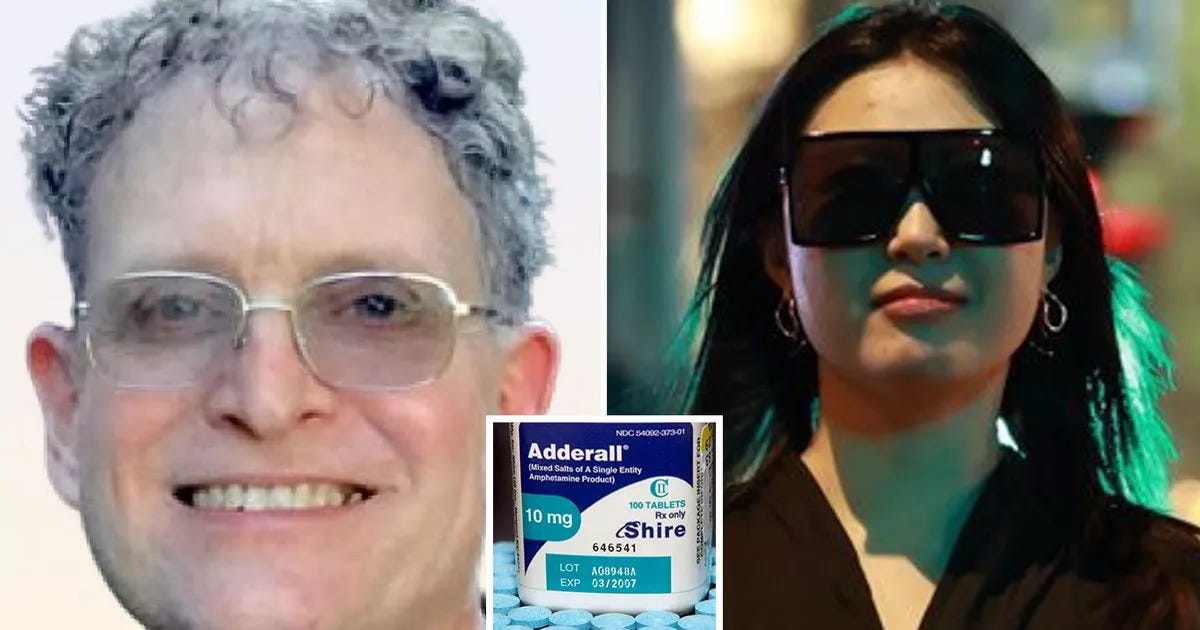
David Brody and Ruthia He
Think medical marijuana ten years ago, but for amphetamines.
I think in a non-criminal way, their damage to our culture goes beyond money, but money is the root of their crimes.
The subversion and psychological damage we have received from Done’s financial hold on ADHD micro-influencers who’ve allowed Done to shape the narrative on ADHD through their financed short form content is irreversible.
To watch these videos, I recommend opening in new tab.
I allege they over associate certain behaviors to be linked to ADHD in part, in an effort to better market their service.
Summary of charges:
A quote from attorney General Merrick Garland:
“…these defendants exploited the COVID-19 pandemic to develop and carry out a $100 million scheme to defraud taxpayers and provide easy access to Adderall and other stimulants for no legitimate medical purpose…”
No legitimate medical purpose.
This indictment marks the Department of Justice’s first criminal drug distribution prosecution against a telehealth company dealing a controlled substances to the populace.
According to the United States Department of Justice, CEO Ruthia He and lead clinician David Brody spent millions on “deceptive” social media ads, targeted at those seeking ADHD drugs.
Once customers had signed up for a monthly subscription, Done prescribers were instructed to allegedly “prescribe Adderall and other stimulants even if the member didn’t necessarily qualify.”
On top of that the business, they submitted false and fraudulent claims to insurance companies for reimbursement for Adderall and other stimulants.
– They are facing charges of:
– Conspiracy to distribute controlled substances (drug dealing)
– Distribution of said substance
– Conspiracy to commit health care fraud
– Conspiracy to obstruct justice
– Aiding and abetting which means the two of them were clapping each other on while commiting crimes
– Forfeiture allegation
What they have done – is commit crimes.
Done had a scheme to distribute Adderall over the internet. Top execs conspired to commit health care fraud in connection with the submission of false and fraudulent claims for reimbursement for meds, and agreed to hide records – to lie.
The plan was introduce people to addictive drugs and in effect extract money both from them and their insurance providers. And it went really well until this happened, but the business is moving on without them.
In the wake of the shakeup, they left thousands without the treatment they had been receiving from Done: access to meds like Adderall and Vyvanse.
Done made around one hundred million dollars and fourteen of them were from alleged insurance fraud.
Rules of prescribing were bent.
I don’t think it’s good for people who want to make profits to be able to profit off things like ADHD.
In my observations, with my bias, I see this as predatory. They prey upon people who probably do need help, but the help is questionable. Plus, taking the meds really feels like it’s working and definitely can make anyone who takes them feel happy, productive and in control of their life.
Done gave away diagnoses left right and center and I would allege that most of those people diagnosed are going to carry that diagnosis with them for the rest of their lives.
Done’s story
Before the Covid lock-downs, getting an Adderall prescription required getting dressed, going out of your home and into a few offices to meet psychiatrists who were required to see you every few months to monitor your relationship to Adderall.
Covid changed the way we relate to doctors.
Done capitalized on all of us being locked inside, looking at our phones more than we ever had. Isolating ourselves and overstimulating with fear, discord, confusion and massive disruptions to our casual way of life.
During Covid, Done, along with a few other startups, introduced diagnosing ADHD over your phone on a thirty minute zoom call. They also advertise a one minute eligibility quiz.
One minute mental health diagnosis?
That’s like a vending machine that can find everything wrong with you with just one drop of blood.
Thirty minutes that could get someone onto pills potentially for the rest of their lives.
Do you know how hard it is to quit amphetamines? Read the stories over at r/Stopspeeding.
Court documents describe Done as following:
“Done was a self-proclaimed “digital health company” that operated on a subscription-based model where individuals (“Done members”) paid a monthly fee to Done. Done advertised that itprovided online diagnosis, treatment, and refills of medication for attention deficit hyperactivity disorder(“ADHD”). Since the beginning of the COVID-19 pandemic, Done arranged for the prescription of over 40 million pills of Adderall and other stimulants and obtained over $100 million in revenue.”
Recovering, active and future drug addicts gained access to amphetamines using the Done service and some of them have unfortunately overdosed and passed. These are consequences that some could allege were enabled by Done’s provision of amphetamines to patients who were at risk. A violation of the Hippocratic oath to do no harm.
Done is a large contributor to the Adderall shortage. Some would argue, the exact reason for it. They have magnified demand and collected from it.
People ordering Adderall through their phone.
“Late diagnosed ADHD” is trending and we know it.
Is it possible that the first time, later in life, you take a drug that makes you feel like all is right in the world, you look back on your life disappointed that you wasted so much time not on medicines that make you productive?
Theoretically, skeptically and allegedly, I think the big P is adjusting the parameters for diagnoses to distribute as many amphetamines as possible.
Allegedly, the employed clinicians at Done were paid for initial visits and were only paid 1/14th of their rate for any follow up with a returning patient.
This Incentivizes getting everything wrapped up for each patient in one thirty minutes session. Refills were not done with another video chat, but a push notification came up on the patients phone on the done app that prompted a patient to press ‘yes’ on a refill and then a live clinician had to hit ‘okay’ on their end to send the script to the pharmacy, allegedly.
Digital pill mill.
Who are Ruthia He and David Brody?
Allegedly, in a slack conversation, included in court papers, head clinician David Brody was quoted as saying “Fuck the FDA (Food and Drug Association) guidelines” in response to internal discussion about their own prescribing guidelines.
Ruthia He was allegedly a more or less a Machiavellian megalomaniac as CEO of Done. At least that was the vibe I got from several articles written about her.
She cashed in on neuro-divergence and was productive and effective. Her twitter bio says she is a “champion of mental wellness.”
Ruthia holds a master’s in product development from Carnegie Mellon University, and a bachelor’s in communications from Peking University in Beijing, China.
Curious to note: nothing to do with medicine, psychology or ADHD.
Ruthia does not appear to be in the business of healing. She made ADHD mecication into a slick business. Customers/subscribers not patients.
If people were getting better from a medicine, must they go back to it every day?
Not unlike many other American drugs like statins, and anti- inflammatories, Adderall is a drug that works as long as you take it and scares you back to taking it when you stop by initiating a reversal of the drug’s effects, presenting as the vengeful return of the condition being medicated against. It is tricky.
David Brody, head clinician at Done allegedly plead not guilty on all charges. Appearing to throw Ruthia under the bus as the responsible party in relation to the crimes.
We will see what the trial reveals.
His lawyer said:
“Dr. Brody worked to promote access to medical treatment for those with ADHD in the face of both widespread stigma and the unprecedented challenges of a global pandemic. We look forward to presenting his case in court.”
He isn’t even a psychiatrist. He has a Phd in neurology and has taught psychopharmacology and has served as a medical director, but I have not found any record of him being anyones psychiatric mental health practitioner prior to his involvement at Done.
Prior to his involvement in Done, Dr. Brody conducted research understanding traumatic brain injuries.
That’s noble work.
Ruthia seems to be the ringleader. She allegedly would strong arm clinicians into imposing her ideas about prescription requirements despite pushback from medical staff.
She used to work at Facebook.
Profits, pills and power.
At Done, anyone who pushed back against over diagnosing and prescribing policies were allegedly forced out of the company.
If convicted, Ruthia and David face 20 years in prison.
Done employees were allegedly shocked about the arrest.
The Internet’s response & the shortage.
The CDC issued the following statement:
Given the national drug overdose crisis and threats associated with the illegal drug market, individuals struggling to access prescription stimulant medications are urged to avoid using medication obtained from anyone other than a licensed clinician and licensed pharmacy.
Basically, we have a crisis of amphetamine dependent individuals without access to amphetamines who may seek meth or something else to quench their desire for dopamine to stave off the looming doom of a long haul stimulant withdrawal.
For some, this is a life-shaking crisis.
It will allegedly affect approximately 50,000 people.
ADHD is real, but some argue it is not. Amphetamine withdrawal is also real. Nobody argues that it is theoretical.
Many ADHD sites and influencers are only really discussing how hard the shortage is.
Done over prescribed medication and over-diagnosed. Nobody is talking about any kind of withdrawing of diagnoses. All the new patients now need their meds.
The only tool they had was Adderall, so everything looked like ADHD.
I am certain each case is unique in it’s own way and I am aware that I am totally applying my anti-med bias to the whole thing…I know. I am not asking you to agree with me, but consider this perspective.
Done’s response
Done disagrees with the arrests and the charges.
As of this writing, it’s the people who are being left out the most… This statement could have been an apology. Instead, they are stating the Justice Department has made a mistake. We will see how that works out for them.
They are doing everything they can to keep the money coming.
They are going to do everything in their power to ensure that patients “receive care.”
They’re like an unruly child who pushed a boundary, found it, and now they will do everything they can to get as close to possible to the new boundary without crossing it.
Either that or they’ll go kaput within a year like all the other ADHD telehealth companies before them.
I don’t know how these things work; court cases, big businesses. I am a hobbyist ADHD historian.
This is just too good of a business to throw away. Customers, I’m sure, are begging to be seen again. The result of being a patient with this company is a literal increase of dopamine, serotonin and norepenephrine. It’s a fantastic product, Adderall. I have taken it many, many times.
Maybe deep down, I am just jealous that I can’t take Adderalls anymore anymore because I pretend to know better.
How Done has shaped the narrative right under our noses.
Done has paid out millions to mental health influencers for years, potentially shaping the narrative to create subscribers.
Done has performed a masterclass in social media marketing. They control the influencers financially. They purchased access to the online ADHD narrative in a way that helped them shepherd in business, where they could then fraud the insurance companies and distribute addictive substances.
Something interesting that increased during the Covid pandemic was the digital de-stigmatization of mental illness or mental health. People started to discuss mental health on their phones openly. This felt good sometimes to share with each other and in a new way, listen to people open up and maybe also take the opportunity to share some mental health struggles through this. It quietly also became an industry.
People can argue over the validity of sincerity – but for better or worse, to many, being neurodivergent has become a virtue rather than a feature.
The label neurodivergent is common, popular and prevalent.
Young adults aged between 20-39.
I feel like I can’t be weird for fun or interesting, or quirky without it being part of a diagnose-able mentality. Or at least choose to experience myself with a defect in my brain functionality without readjusting my chemistry with amphetamines.
The archetypes of our era are written in the DSM.
A reversal for me is the change in from what to what. When I was a kid, I was diagnosed and medicated to fit in and be normal. The bridge they were selling to my mom was that I was now neurotypical.
Now, it appears that if you are ‘normal,’ you are ‘masking,’ and with a diagnosis (and often) medication, you can unmask, but remain neurodivergent despite treatment.
Simplicity are obscured in complication. It seems like people are taking drugs and feeling good. But it must not be that simple.
The definition of ADHD is being shaped by a bunch of charismatic millennials and Gen Xers (probably on amphetamines) who are getting deals with a company that has just been accused of massive fraud.
Done pumps millions of dollars into the pockets of many ADHD influencers who in a way shape the entire narrative about ADHD, who has it and who should be diagnosed.
It seems like video after video is suggesting some weird, random quirk of humanity, presenting an array of personalities to relate to and linking them to ADHD until they relate to you.
There is a serious economy of ADHD influencers. They post new content multiple times a day, reinforcing the experiences of ADHD and offering advice for navigating our world.
And they
all
have
Done
deals.
( A lot of them have appeared to delete their partnership videos post scandal.)
They get to make money making short form content on Instagram and Tiktok because of companies like Done. That’s a great deal and I can imagine it’s hard to turn down.
I’d be curious to see a contract from done and what kind of coaching they give their influencers.
By allowing these influencers to promote the social media modified definition of ADHD, they could plant seeds of consideration into people that maybe the reason they struggle with achieving what they set out to achieve and being the person they wish they were is because they have ADHD and these medications are going to get them on the right path.
A lot of these videos mention things like:
Rejection sensitive dysphoria
Time blindness
Liking to have three drinks at once
as indications of ADHD.
They do not appear to be in the DSM.
These micro-influencers use titillating, relatable, and subversive advertisements to hook followers, create engagement and hopefully wrap you into a funnel that leads to a Done membership.
I don’t believe the companies who manufacture and sell Adderall is upset about the shortage. It’s not driving away business.
Ruthia He, your 100 million dollar fraud scheme is over and I hope it was fun.
David Brody, you helped.
You guys almost got away with it if it wasn’t for that darn American Justice System.
So long and thanks for all the amphetamines.
I hope you both understand what you’ve done and seek forgiveness.
If you (reader) are interested in my book, Hocus Focus: Coming of Age with ADD and its Medicines, check it out here. It is the great American Adderall memoir.
Sources
https://www.poetryfoundation.org/poems/43997/the-rime-of-the-ancient-mariner-text-of-1834
https://www.modernhealthcare.com/digital-health/done-global-ruthia-he-david-brody-charges
https://www.usuhs.edu/profile/david-brody-md-phd
https://emergency.cdc.gov/han/2024/han00510.asp
Thanks for reading R.L.’s Substack! Subscribe for free to receive new posts and support my work.
 R.L. Kramer
Leave a reply to Susan Cancel reply